The beauty in mistakes is that they can be a mirror, not a wall.
A few weeks ago, we explored how learning-by-teaching can surface hidden gaps in understanding. Students who coached an AI through a chess puzzle ended up mastering the material more effectively than peers who solved it alone. By forcing themselves into the role of a teacher, they confronted their blind spots head-on.
But that study had limits: the learners were all computer science majors, and the task was narrow. Could the same principle work for broader skills—like writing—in a way that mirrors the average student’s real mistakes?
A Quest to Imitate Error
Writing is wonderfully subjective and rigorously rule-based at once. That duality makes it a perfect test bed for error-driven learning. Researchers in Japan recently built a learning companion AI agent (LCAA) designed to mimic each student’s writing patterns—and, crucially, their errors. Here’s the framework they tested:
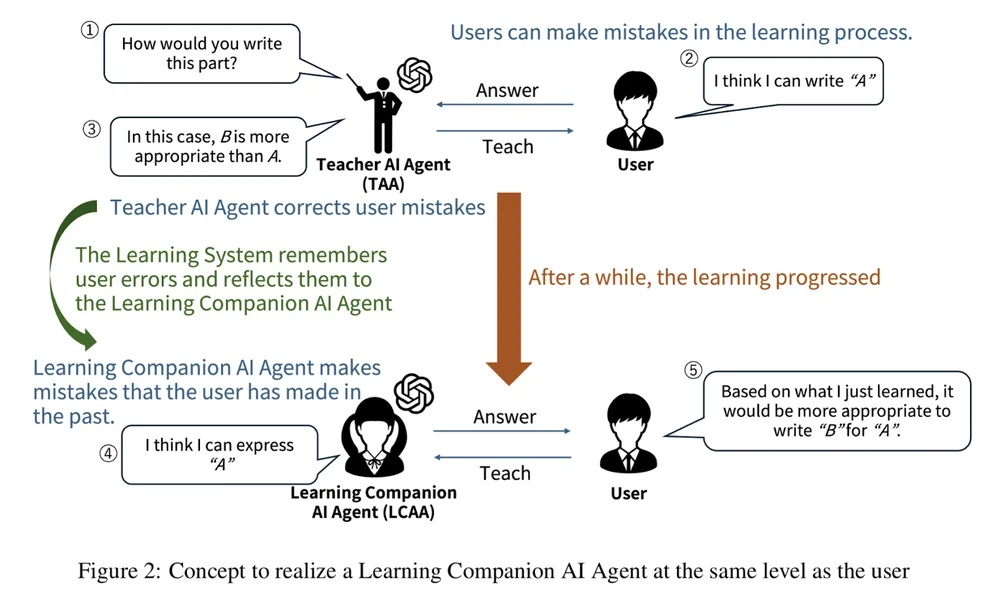
They compared two approaches:
- Comparison Method: Simply match the overall proficiency level of the student.
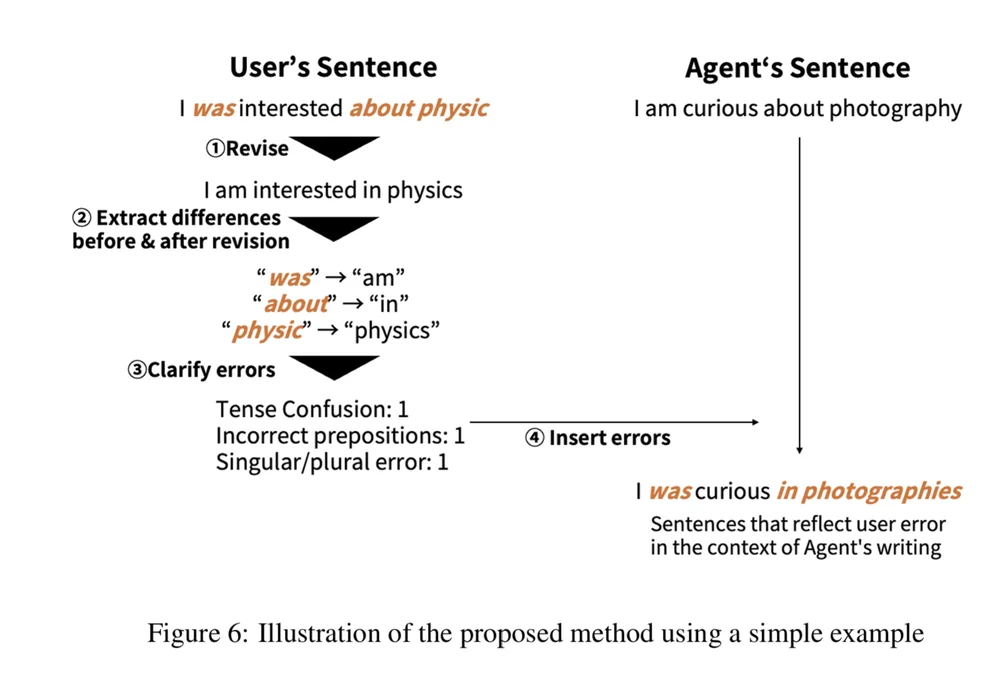
- Proposed Method: Analyze the type and frequency of errors (e.g., tense, prepositions) and recreate them with the same cadence.
The Proposed Method decomposed errors using Grammarly feedback, then regenerated writing that reflected each learner’s unique pattern of mistakes:
When the AI’s outputs were compared against each student’s original draft, the Proposed Method produced far more realistic mirrors of student errors than the baseline approach:
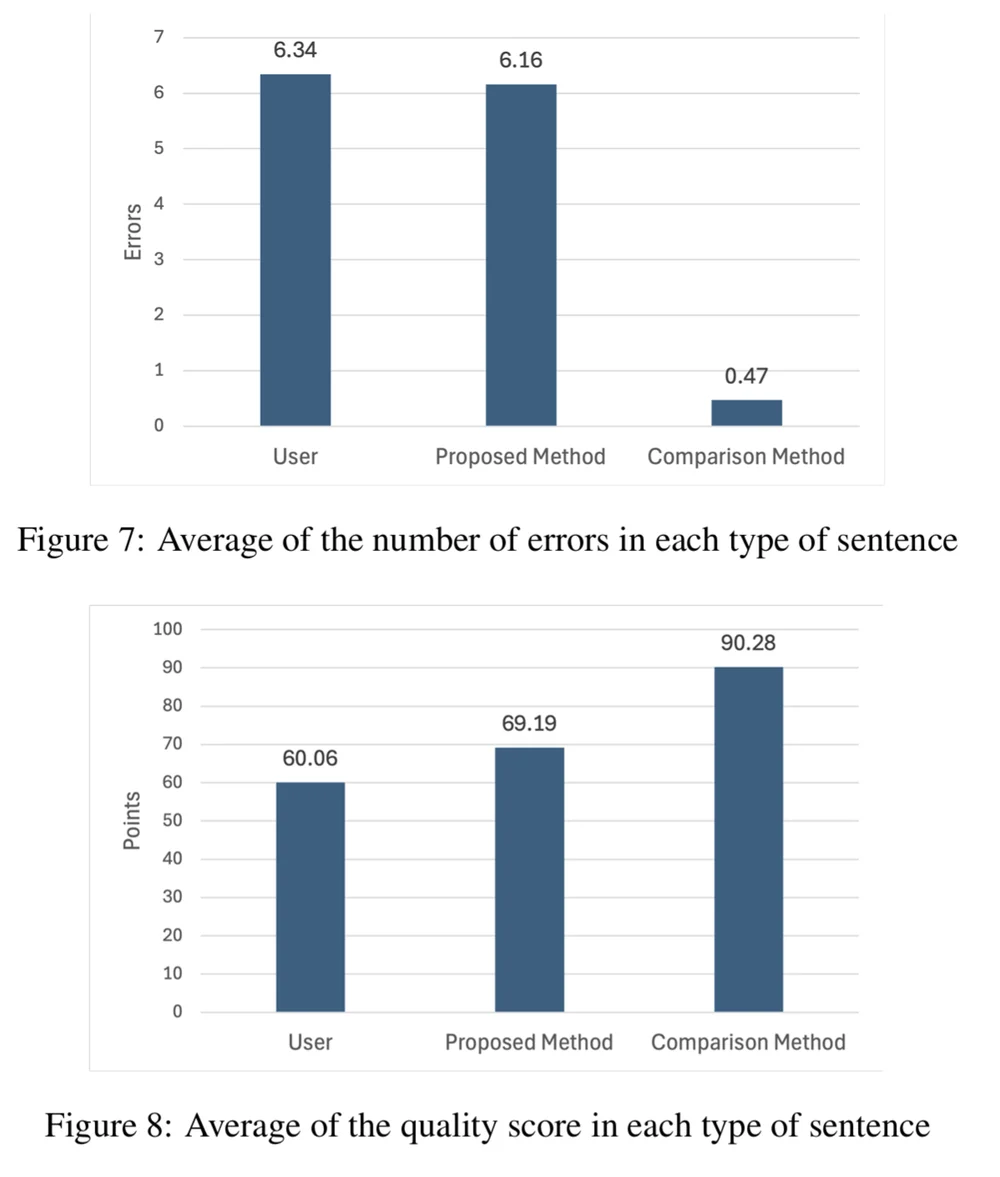
Individually, these charts aren’t shocking. Collectively, they hint at something powerful: if an AI can convincingly imitate a learner’s mistakes, it can become a credible peer for error-spotting and error-correcting practice.
Why Error Mirrors Matter
Teachers have long used error correction and multiple-choice distractors to sharpen metacognition. But those exercises are usually one-size-fits-all. Two students with the same “grade” may struggle in completely different ways—one with commas, another with verb tenses. Generic practice underserves them both.
Time is another constraint. Homework happens hours after class, when details have faded. Packing enough targeted questions into a 30-minute lesson with dozens of students is tough, so some gaps survive long enough to calcify into habits.
How Grassroot Turns Mistakes Into Momentum
Grassroot tutors—human and AI—zero in on the specific errors students make across subjects. We insert corrective practice inside live sessions, while the concept is still fresh. Instead of generic drills, we bring students face-to-face with their own error patterns and guide them through the fix, without judgment.
Our tutors pair expert pedagogy with a supportive tone. The goal isn’t to avoid mistakes; it’s to use them as fuel. When students feel safe to try, miss, and try again, their confidence and competence compound together.
Ready to learn with a judgment-free partner? Meet a Grassroot tutor who learns your patterns and helps you turn every misstep into momentum. Start learning →
Source: Moribe, Sosui, and Taketoshi Ushiama. "Imitating Mistakes in a Learning Companion AI Agent for Online Peer Learning." 2025 19th International Conference on Ubiquitous Information Management and Communication (IMCOM). IEEE, 2025.