The Educational System
Learning is often treated like a chore – a means to an end – and the way the current educational system is set up, that's no surprise. Study so you can do well in high school. Do well in high school so you can attend college. Attend college so you can have a successful career. There is a clear, pragmatic value-chain to the process of studying.
Unfortunately, this brings a series of rules and requirements that can feel confining for many students. Traditional, textbook-based learning encourages a one-size-fits-all approach that leaves little consideration for a student's learning styles, preferences, and interests. Students are taught both what to think and how to think, in order to satisfy the learning requirements present in a curriculum. There's little room to challenge this rigid dogma – students simply have to learn that way because that's how it's always been done and that's how they get into college.
But what if learning didn't have to be so rigid?
Over the past few weeks, we here at Grassroot surveyed over a hundred students throughout several districts in the Chicagoland area to assess attitudes toward learning – namely, what students are interested in studying and why. The cohort we surveyed was mostly evenly distributed across all four years of high school, as to control for factors such as age and grade level playing a role in the analysis.
The Data
Among the various questions we asked the student cohort, three are especially of note.
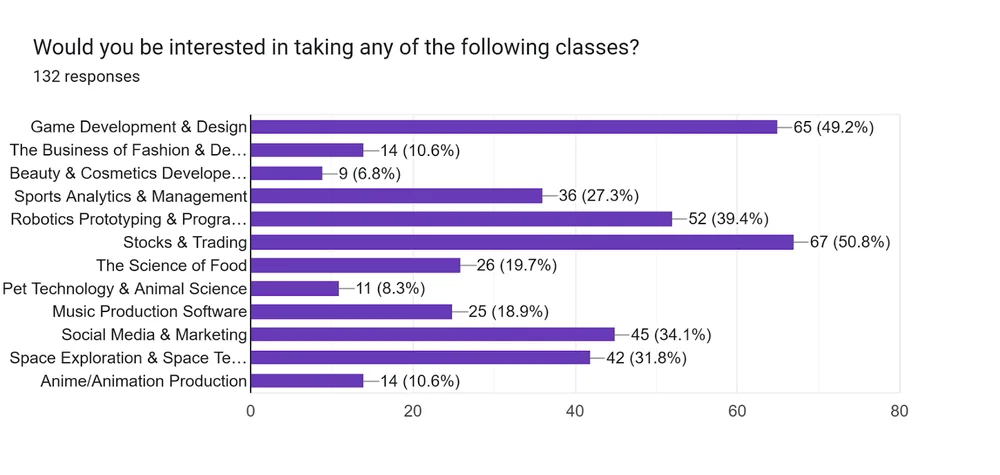
- Would you be interested in taking any of the following [interest and hobby-based] classes? This question included hands-on options such as game development and pet technology
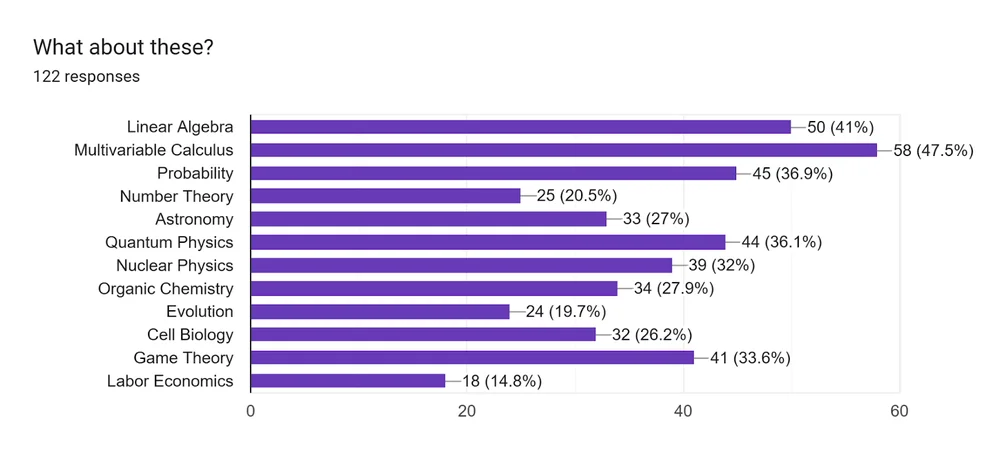
- What about these (academic) classes? Options for this question were limited to the theoretical: linear algebra, game theory, and so on
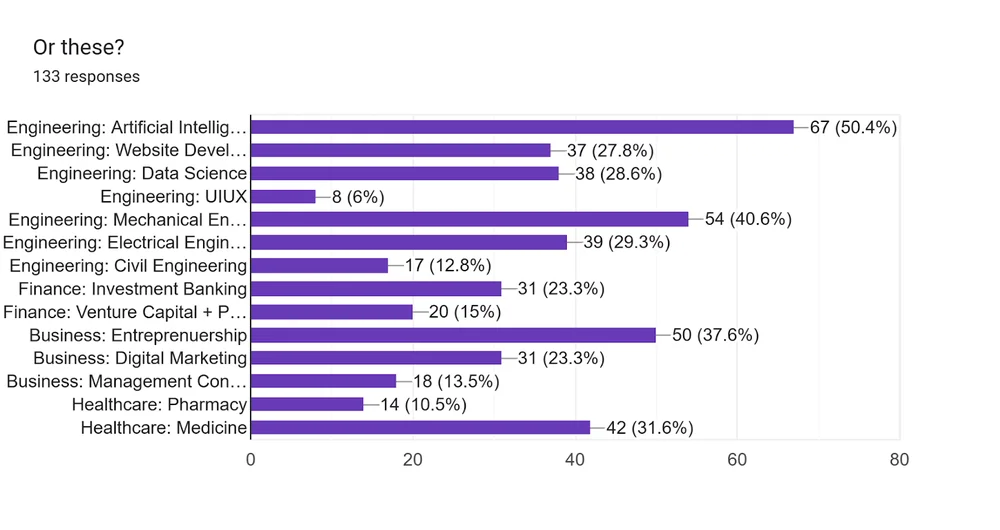
- Or these (career-focused) classes? Here, we allowed students to choose from a wide variety of career-related topics, such as those in healthcare and engineering
Note that most courses encompassed within the questions listed above were STEM-based, as we were speaking to students in STEM classes.
You'll find the responses to each question below:
Unpacking The Results
If you have a few moments, I'd encourage you to peek through the responses above to see the nuances in interest level across different course selections.
What I find most interesting, though, are the numbers on a few interest-based and career-based topics. Game development, robotics, AI engineering, and stocks & trading all hovered around 50% interest (or higher) in the cohort. To be fair, multivariable calculus was not far beyond (likely as many survey respondents were gearing up to take the course after AP Calculus).
But why did only a third of students express an interest in probability?
We get it. Probability and statistics are not the most exciting topics to many students. Who wants to read through textbooks with problems that involve analyzing different colored marbles in bags or assessing the selection of a certain number of roses and lilies (with and without replacement)?
The thing is, the study of probability is integral to understanding variance in the stock market and thus, trading – and it doesn't take an MBA to know that. Students who are interested in trading may very likely be interested in probability as well, but many of them have trouble recognizing that due to the way that probability tends to be taught. When students can see that studying probability is not just a means to an end (e.g. a course taken to help them get into college), but also an opportunity to have a direct impact in their life through finance, it becomes a different ballgame.
Funnily enough, when asking students an open-ended question about the topic of their dream class, the most common answer was some derivation of "how to make money quickly." This is pretty unsurprising – I mean, who doesn't want to make money? But because so much of the current educational system focuses on the theoretical rather than the practical, most high schools provide very limited financial education.
Sure, some schools may introduce very basic accounting, and at others, students will have the chance to understand the framework of supply and demand in AP Microeconomics. But in neither case will students truly be introduced to the importance of compounding interest, nor will they have the chance to apply this principle in practice to really make it stick.
Why it Matters – and What Educators Can Do
Interest is the key driver to learning. For students to truly enjoy learning and wish to make the most out of it, it's imperative that learning be treated as an opportunity to grow and experience tangible achievement – not simply as a way to collect arbitrary letters on a report card. Tailoring lessons to a student's needs can generate stronger interest. And stronger interest means better outcomes.
Take the example of a student who struggles in physics but loves playing football. Explaining projectile motion through the abstract lens of parabolas on graph paper will likely resonate with the student a lot less than, say, articulating why a 45-degree launch angle results in the maximum distance a football can be thrown, absent air resistance. Here, the lesson becomes more intuitive, anchored by personal experience.
The example above is simple, but the principle remains; once a lesson is concretized in a way that a student understands, at least two things occur thereafter. First, the student starts to understand the direct applicability of the lesson to their life and second, they realize that perhaps they actually did know more about the subject than they had anticipated. Both of these moments of understanding can work in tandem to promote learning within a student.
But in such a case, we're talking about only one student and one lesson. How can this effect be scaled enough to truly have an impact?
Easier Said Than Done…Or Is It?
We recognize that educators are extremely limited in their capacity to serve the needs of every student while nurturing their interests. Primary and secondary school teachers often have class sizes that reach thirty students – with six classes or more a day. Educators lack both the data and the time needed to personalize their lesson plans to every pupil.
At Grassroot, our approach is different. Thanks to the marriage of technological advancement and tried-and-true pedagogical methods, we do not confine the learning of a curriculum to an immutable series of rules. We also choose not to alter a curriculum simply for the sake of easier understanding. Instead, we enable each and every student to reach proficiency of their chosen subject by providing learning tailored to their needs and interests. And that's why at Grassroot you'll find that you can cover topics beyond what you'll find in a traditional classroom – and here, you can do it at your pace, your way.
Ready to experience personalized learning? Explore how Grassroot tailors education to your unique interests and learning style. Learn more about our approach.