Staying Ahead
In last week's piece, we explored two studies published this fall that delve into how AI has affected the job market thus far – and how it is primed to do so in the future. The data suggest that service professionals and software engineers may be especially vulnerable to AI, while those with trade-based careers may expect greater insulation. In light of the uncertainty that looms over many career paths in the wake of AI proliferation, however, we recognize that it's difficult to pinpoint with certainty which paths are "safer" and which are more at risk.
We hope our analysis on the studies from Stanford and Yale can provide some food for thought if you are in the process of exploring careers, but we are not here to say what careers you should or should not pursue. Rather, we're sharing a few key tips you can follow to best position yourself for success in the era of AI, regardless of the path you choose.
Let's dive in.
Use AI More
What's fundamentally important to position yourself for success in the AI era is that you actually start using AI tools (if you haven't already), and experiment with them (if you already have a bit of exposure). Try different LLMs and see what you like or dislike (our piece here on comparing ChatGPT, Claude, and Gemini with college essay writing may be an interesting starting point). Explore different modes to see how an LLM's "reasoning" differs from its searching capabilities. Become familiar with what AI tools can and cannot do well, just as we've done with assessing ChatGPT as a study tool.
In fact, learning how to use AI effectively is a skill in itself. Take a look at two approaches – based on slightly different prompts – that ChatGPT takes when I ask it to help me find the five best burger spots in Chicago.
Example 1: A simple prompt


Example 2: A prompt with request for clarification
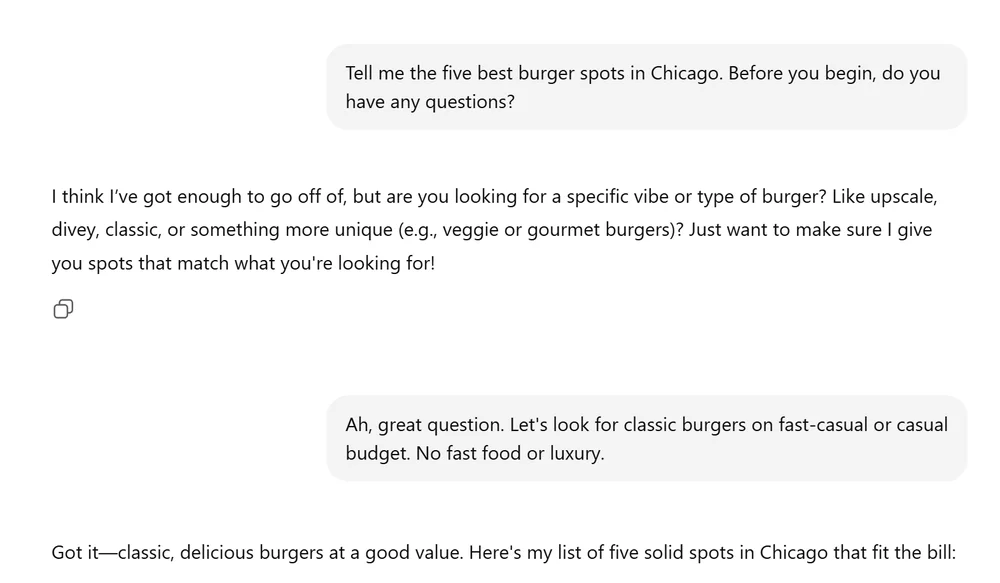

You'll notice immediate differences in the responses. Not only did I receive a different list, but the context behind each item is also different. When I specify that I'm clearly looking for a quality, budget-friendly option, ChatGPT makes sure to include price in its reasoning. This is in contrast to the first prompt, which provided a kind-of catch-all description, as it wasn't sure what exactly I was after.
The second prompt was more effective for my goal because I gave ChatGPT the chance for clarification, rather than having it just zip off an answer. Sounds simple enough, but many of us don't fully leverage ChatGPT's strengths during our conversations.
Burgers aside, studies have shown increased brain activation in users who treat LLMs as a thought partner versus those who let the LLM do the driving. This is where prompt-engineering comes into play; spend some time studying the different types of prompts available and try A/B testing for effectiveness. Understanding the nuances of prompting – whether writing a simple prompt, chaining back and forth, or applying a mega prompt – is a subject for another piece, but you don't have to be an AI expert to have a bit of fun with prompt experimentation.
You can also get more familiar with using LLMs to complete entirely novel tasks. If you're curious about designing a website but don't have a technical background, for example, you can try vibe coding with Claude, whereby the directions you articulate in human language are translated into actual code by the LLM. Perhaps we'll dive further into vibe coding in another piece, but it's also something that you can learn on the Grassroot platform.
Experimentation, ultimately, is a great first way to maximize your use of LLMs and understand their capabilities and limitations. Before you make any career decision, it's always best to know what exactly you're up against.
Develop Skills That AI Cannot Replicate
Next important tip to remember: even though LLMs have their own form of intelligence, they are not human. They may be becoming increasingly sophisticated in how they process and interpret information, but they cannot replicate everything a human can do. This is especially apparent when examining skills that do not rely on logic alone.
Below, see what ChatGPT has to say when I ask for help with a hypothetical negotiation when buying a house.
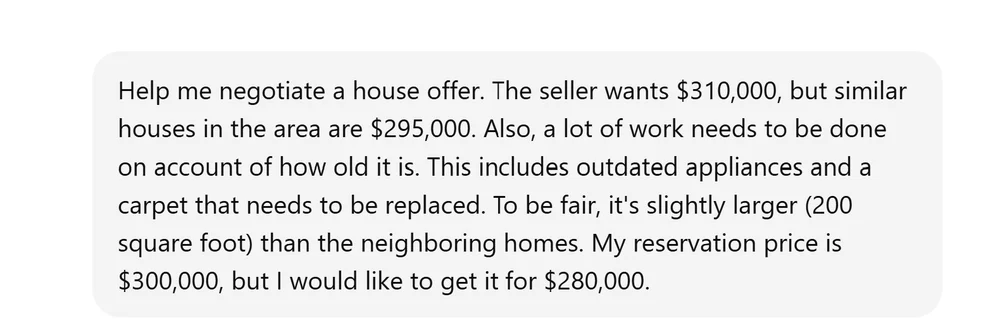
My above message was met with a few templates for email responses to the seller, as well as this negotiation strategy:
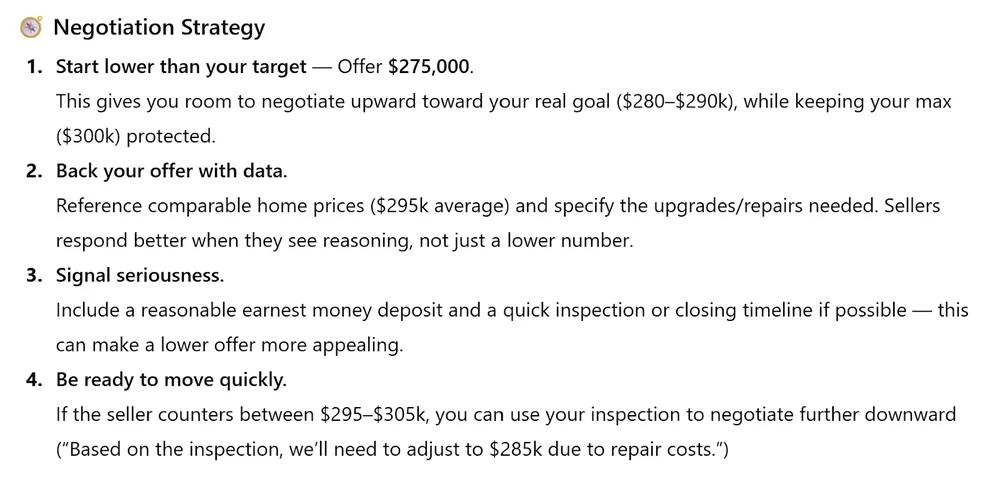
Great – we have some tangible steps to move forward from. This is especially apparent with the suggestion to start lower than my target and back my offer with data, which is quite logical. But if there's one thing I remember from my AP English Language & Composition class, it's that unit on rhetoric – and persuasion requires a holy trinity of ethos, logos, and pathos. Logic alone won't cut it.
How do I follow the suggestion to "signal seriousness"? How do I apply the pressure needed to "move quickly"? ChatGPT's advice is great on paper, but applying it in practice is a whole different matter entirely.
Being persuasive, developing emotional intelligence, expressing empathy – these very human traits are vital across many workspaces. This is why careers in education, as showcased by the Yale study we covered last week, are more insulated to the exposure of AI replication – just imagine having to rely on ChatGPT to calm down a classroom full of rowdy 6th graders. Not every job relies on the same level of human touch as a teacher, but this doesn't mean you can't find ways to upskill soft skills used in your current or desired career path.
Keep Learning to Stay Ahead
Finally, we have a tip that seems obvious on the surface, but is quite difficult to apply in practice. Say you're using an LLM for assistance with a history research paper and the output is a laundry list of dates and statements – are you going to take the result as is, or are you going to vet the information for accuracy?
Or, imagine you're talking to ChatGPT, iterating on a back-and-forth discussion to ideate on an essay topic, such as whether Santiago in Hemingway's The Old Man and the Sea is a hero. How do you know when a satisfactory output has been reached?
In other words, when do you say, "Good enough; I have what I need"?
Check out my below exchange with ChatGPT on this very topic.
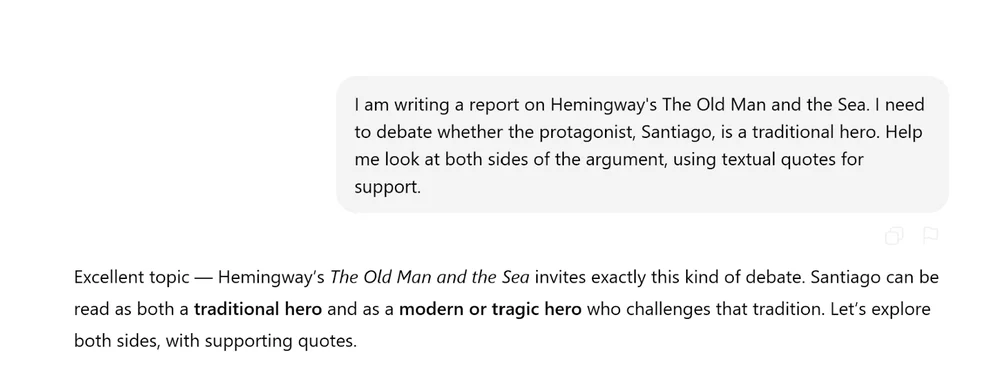
Per usual, ChatGPT presents both sides of the argument. Below, you'll find the textual support on why Santiago could be seen as a hero.
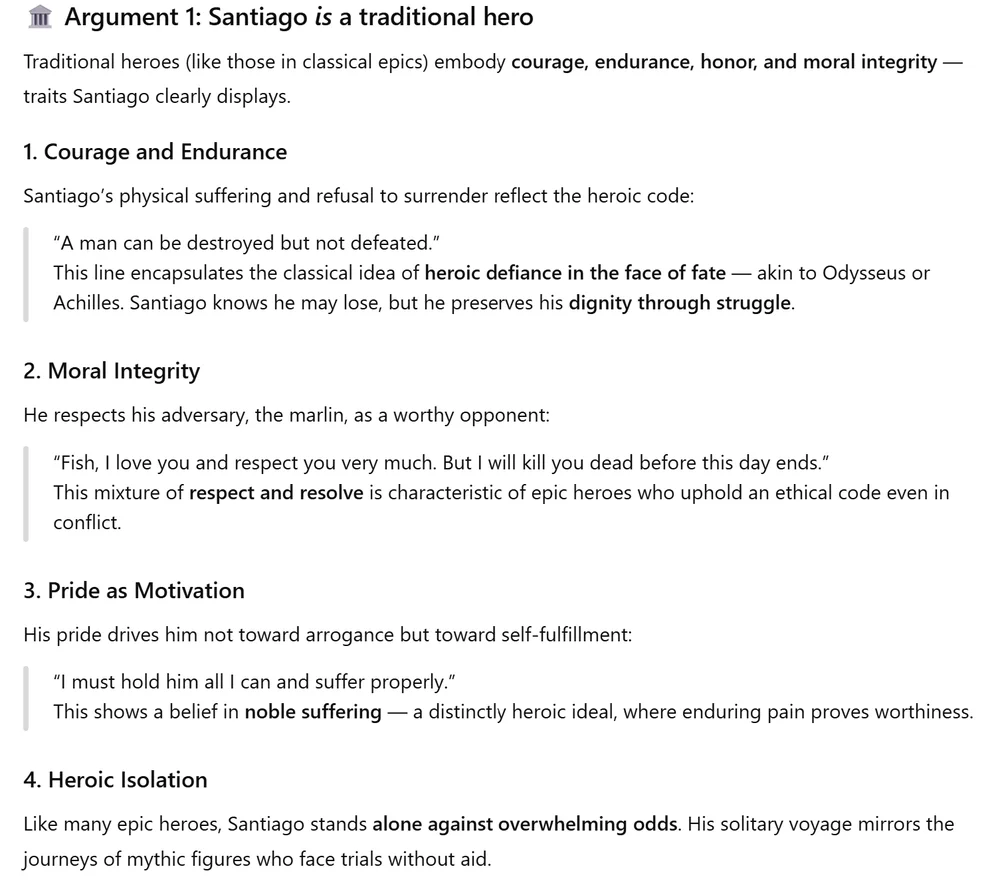
So far, so good. We have a few points to work from, and textual quotes to back it up. What about the other side of the debate? Why could Santiago not be seen as a hero?
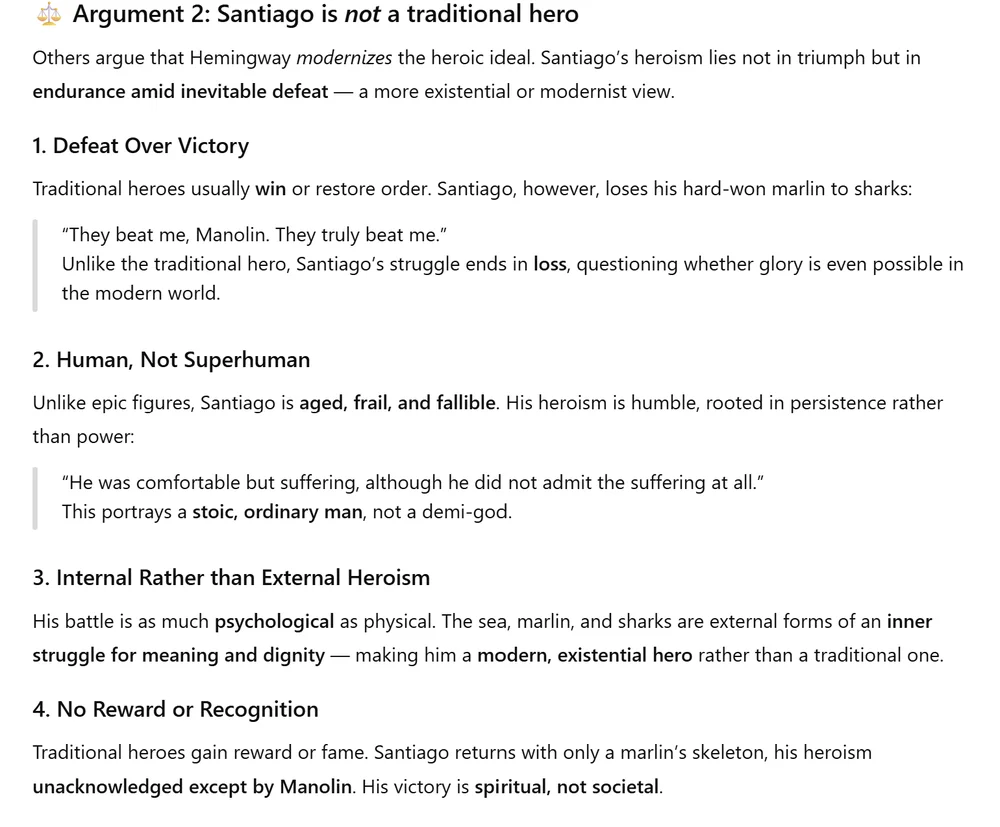
Okay, so four additional points to balance out the first group of items. However, from someone who has written an essay on this specific topic, a few things jump out to me.
- ChatGPT's point on defeat over victory could be easily used to convey Santiago's perseverance, especially given the textual support's proximity to the end of the story, when Santiago's optimism remains steadfast, evidenced by his dreaming of the lions.
- ChatGPT omits a huge theme of the book integral to the story: Santiago's pride as his downfall – his hubris being responsible for his failure.
Had I not read this book multiple times (and without my English teacher's incessant hammering of the above point on pride), I could have very well missed a key message of the book. Knowing what I know now, I can reply to ChatGPT with my thoughts and iterate for a better response. But without that knowledge, I would have been kept in the dark – with a poorer essay as a result.
The disclaimer, ChatGPT can make mistakes, exists for a reason.
Think about it from the perspective of sports. Most athletes who play a sport benefit greatly from having a coach. A coach is not expected to be more athletic than their pupil. A coach does not even need to be more skilled than their pupil. But a coach should possess the knowledge and experience needed to check their pupil when mistakes are made.
You as a human will never be able to outcompete an LLM in its ability to rapidly parse text. Your thoughts and vocalizations cannot match the speed of output seen in ChatGPT. However, it's incumbent on you as a decision maker to know when AI has made a mistake and have an idea how to rectify it. This is why it's critical for you to continue developing knowledge in your respective field and studying emerging trends, arming you with the expertise you need to stay ahead.
There's no substitute for human experience.
Conclusion
We here at Grassroot cannot tell you what the future job market holds, but we recognize that there are steps you can take right now to best position yourself for that uncertainty. Whether you're gaining familiarity with AI, honing your soft skills, or staying curious, you'll upscale yourself in the rapidly-changing career landscape. The good thing about using Grassroot is, you can do all three at once – all you have to do is sign up.
Ready to stay ahead? Join Grassroot and learn how to leverage AI effectively while developing the irreplaceable human skills that make you invaluable in any career.